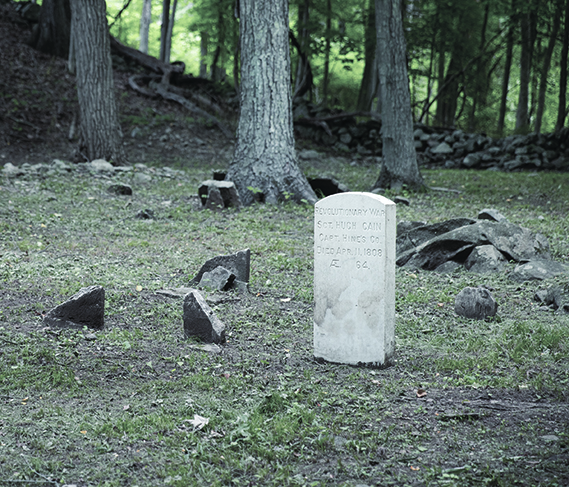
 If you have lived in Ridgefield for any length of time, you know the feeling: you are driving a familiar road near a driveway you have passed a hundred times, and suddenly you notice it. A few leaning monuments. A rusty iron gate. Taller grass than seen around Ridgefield’s weekly-mowed lawns. An ancient sugar maple tree pushing into a stone wall built by farmers long ago. One of Ridgefield’s tiny burial grounds has been there for two centuries, hiding in plain sight.
In a place that commemorates the Battle of Ridgefield, from North Salem Road to Main Street, to the Keeler Tavern and beyond, among its well-kept historic homes and handsome churches, some of our most moving history rests in the quieter corners: the small family cemeteries tucked beside old roads, former farms, and the neighborhoods that grew around them.
Ridgefield has more burial grounds than many people realize. The largest ones are easily visible from the road. Somewhat off the beaten path is the two-acre cemetery in Branchville (near the Elementary School). The cemetery adjacent to the ballpark on Ethan Allen Highway is smaller still; only one-third of an acre. Each of these cemeteries is easily accessible for visitors, with parking either on-site or within easy walking distance.
Public listings identify about twenty active and historic cemeteries in town, from larger and better-known places such as Fairlawn, Mapleshade, Ridgebury, and the Saint Mary’s Cemetery (each with plots available); Branchville, Ridgefield, Olde Town cemeteries (aka Titicus, including Hurlbutt), where any remaining plots are already spoken for. Ye Burying Yard on Wilton Road East is labeled as the oldest cemetery in town with a large monument dedicated to 30 of Ridgefield’s founding families.
Finding and accessing the smaller cemeteries in town (those that have as few as a dozen gravestones or sometimes three times as many) is somewhat more difficult. Often referred to as “pocket cemeteries” here and throughout the country, small cemeteries containing the remains of only one family (or a few) can be found in many countries around the world.
There is a landscape lesson here, too. Many of these cemeteries seem oddly placed only because modern Ridgefield has grown around them. The old roads, farms, and districts came first. The subdivisions, widened routes, school runs, and commuter patterns came later. The cemeteries did not move; we did. That is why they can feel so startling. They interrupt the present with a reminder that this town has always been more than its current moment.
Most pocket cemeteries in Ridgefield are named after families: Beers, Davis, Gamaliel Smith, Lounsbury, Seymour, and Selleck. Often, some of those interred therein may have been relatives or neighbors. These cemeteries may be small, but each one holds a piece of the old town map. A pocket cemetery may contain only a handful of markers, but it can preserve the memory of a farm family, a neighborhood, or a vanished crossroads. The reasoning behind these cemeteries is simpler than you’d think; accessibility for family to visit their deceased loved ones. Although Ridgefield may seem small by today’s standards, and with a car, traveling across town in the 1700s was potentially a day-long endeavor.
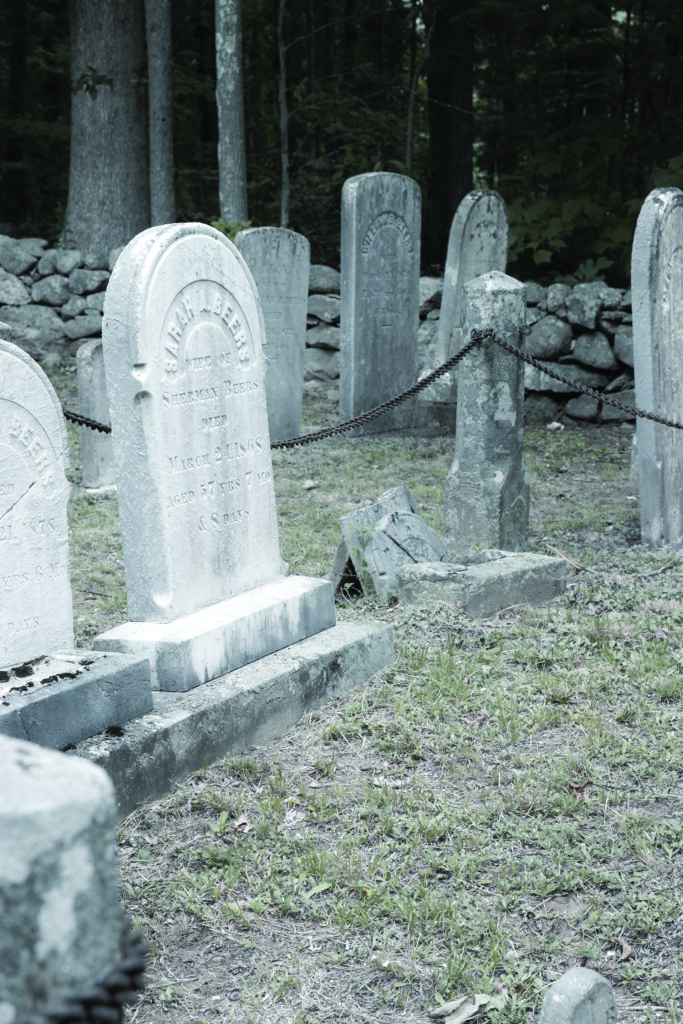 The stones speak in the plain language of earlier Ridgefield. Some inscriptions count a life in years, months, and days; many mention the names of surviving spouses or parents. Some markers in Ridgefield’s cemeteries are military, connecting local families to the Revolution, the Civil War, or later service. Some sit in family clusters that show kinship and neighborhood ties more clearly than any map. Others are broken, weathered, or half swallowed by grass. Even then, they matter. A marble tablet, a fieldstone, or a barely legible name can tell us about settlement, craft, belief, grief, and the way one Ridgefield generation remembered another.
If you go looking for them, go gently. Seymour, on South Olmstead Road, is probably the best one to visit first. Most of Ridgefield’s pocket cemeteries are fragile, and several are on or near private property. Respect signs, walls, gates, and neighbors. Do not rub old stones or try to clean a marker yourself. The Town’s Graveyard Restoration Committee has a mandate to maintain and restore old town cemeteries and seeks volunteers to help care for gravestones.
For more information about Ridgefield’s pocket cemeteries, please visit ridgefieldhistoricalsociety.org or email thomas.m.mcmanus@gmail.com•
