Some of our 068 readers are from the generation that used encyclopedias to write their school papers. Some might remember the launch of Google and Ask Jeeves. Today’s students, however, are equipped with more advanced and constantly evolving technology than we could have ever imagined when we pulled the Encyclopedia Britannica Volume “T” off the shelf. We talked with local educators about the use of AI in the classroom, what’s being done to keep our students safe, and how it might change the face of education.
The Genie is Out of the Bottle
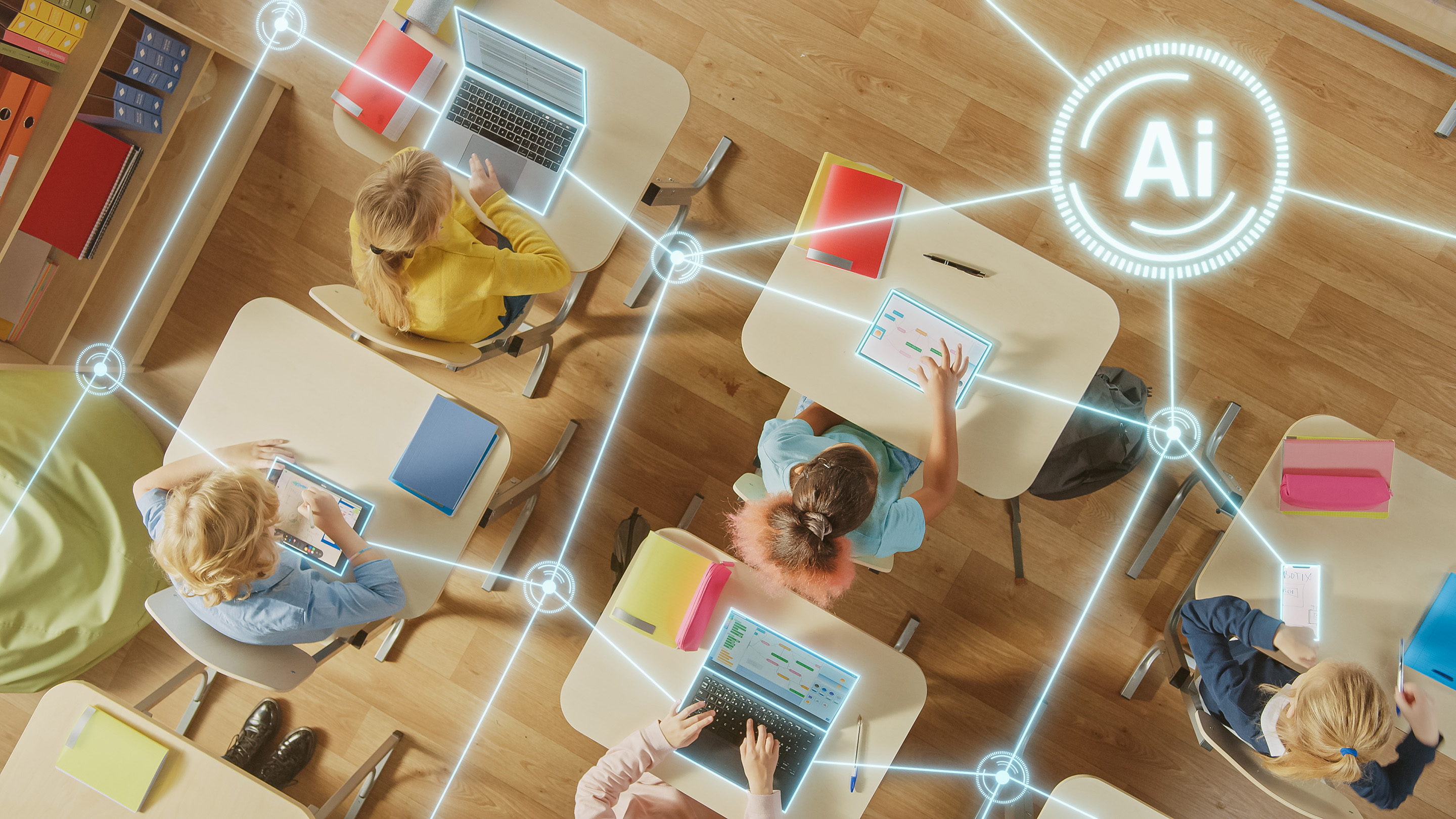
AI is here to stay, or, as Michael Yagid, Assistant Principal of Ridgefield High School, says, “The genie is out of the bottle.” The Ridgefield Public School district has taken a tiered approach to using AI in the classroom. Starting in middle school, students are introduced to the topic through Innovation Lab, a computer science course which has a closed-off system as opposed to the regular ChatGPT. At the high school level, Yagid says they use Google Gemini, which falls under the Connecticut acceptable classroom use (13+) and seamlessly fits into the existing Google platform. New Fairfield High School students also use Google Gemini. “The first concern is the safety and security of our students’ data and privacy,” says Christine Haddad, a veteran educator and Library Media Specialist. Both districts have ongoing professional development days for teachers to demonstrate how they can use AI tools in their curriculum writing and workflows.
Within the school day, RHS teachers monitor and control AI usage by having students use a district-issued Chromebook. “Teachers can toggle AI on and off – for instance, when they want the students to write on their own,” says Wes DeSantis, Director of Educational Technology of RPS.
Easy Way Out or Better Way Forward
Once students go home, their usage of AI is a different story. “If kids, especially teenagers, see a shortcut to getting something done, it can be very tempting to use it,” says Haddad. Student cheating wasn’t invented with the advent of AI, but it can make it easier and quicker. RPS, however, did not buy into any of the AI detector tools, which are notoriously fallible. “It’s a cat and mouse game,” says Yagid. “The detector gets good, and then the AI gets better.” Instead, the RPS district advises teachers to monitor students’ progress on projects. Through a program called GoGuardian, teachers can access revision history and see how long a student has been writing, what edits they’ve made, or if there is an excessive amount of cutting and pasting. “If all of a sudden the final product is vastly different, it’s time for a conversation about academic integrity,” says DeSantis.
While AI is not built into the curriculum yet, teachers need to learn to identify what the AI language looks like. “They need to address the use of AI with their students, meaning they need to be clear about what level of AI usage is acceptable for every given assignment,” says Yagid.
 Leveling the Playing Field
Students might cave to relying too heavily on AI because they are behind the eight ball and didn’t manage their time well, or because they are struggling with the material. Either way, AI is a tool that can help. “As opposed to ‘write this for me,’ students can use AI to explain a topic they are struggling with or create a study schedule for preparing for a test,” says Yagid. Showing students how to use AI in constructive ways takes guidance from teachers.
DeSantis notes that AI translation features have been a game-changer for students for whom English is not their native language and the district may not have the staff with those language skills. AI has made the translation easy and seamless.
Teachers have always had to differentiate their instruction; it takes time. “With AI,” Yagid says, “a teacher can create one instructional model and, without divulging any personal information, can nearly instantaneously customize it to each student’s learning needs.” AI offers the possibility of closing learning gaps and leveling the educational playing field by creating personalized learning for students, regardless of their economic status.
Humans First, Humans Last
Yagid notes that educators and all users of AI need to be aware of what are called “hallucinations,” or errors – one of the reasons why AI is not recommended for the younger grades. “Students need to be taught how to analyze the output that the AI model is producing,” says Haddad. One of the mantras RPS holds is humans first, humans last. “We need to understand what we are putting into the chat or language model, but also, we never take product that is created by AI and blindly use it,” says Yagid.
AI will eventually be something that will be embedded in our everyday lives, as opposed to having to seek it out. It is, however, a constantly evolving technology that needs to monitored. “We have to be flexible and be willing to keep learning and identifying issues and reacting to them,” says DeSantis.•
